| Standard & Protocol | IEEE 802.3 for 10Base-T IEEE 802.3u for 100Base-TX IEEE 802.3ab for 1000Base-T IEEE 802.3z for 1000Base-X IEEE 802.3ae for 10GBase-X IEEE 802.3x for Flow Control IEEE 802.1D for Spanning Tree Protocol IEEE 802.1w for Rapid Spanning Tree Protocol IEEE 802.1s for Multiple Spanning Tree Protocol ITU-T G.8032 for ERPS IEEE 802.1P for Class of Service IEEE 802.1Q for VLAN IEEE 802.1AB for LLDP IEEE 802.3ad for LACP |
| Management | SNMP v1/v2c/v3 centralized managed equipment, RMON, Port Mirroring, LLDP, QoS, DHCP Server, DHCP Relay, Bootp, TFTP, SMTP, RARP, port speed limit, port isolation, port statistics, file management, online upgrade, log information, Syslog server, Web based |
| Security | User privilege classification, ACL, SSH/HTTPS protocol authorization, link flapping protection, port loopback detection, access control, SNMP, RMON, IPDT, IPv6DT, Smart-Link, NAT, port alarm, temperature alarm, power alarm, network load alarm |
| Switch Function | 802.1Q VLAN, MAC, static aggregation, LACP, ARP, storm suppression |
| Unicast / Multicast | IGMP-Snooping, MLD-Snooping, GMRP, IGMP, MLD, DVMRP, PIM-SM, PIM-DM, IPv6-PIM-SM, IPv6-PIM-DM |
| Redundancy Technology | Ring, Chain protection, MRP, STP/RSTP/MSTP, ERPS |
| Routing Technique | RIP V1/V2, RIPng, OSPF, OSPFv3, ISIS, VRRP, IPv6 VRRP, BGP |
| Troubleshooting | Ping, Traceroute, Network Cable Diagnosis, SFP Digital Diagnosis |
| Time Management | NTP Client, SNTP, Time Zone Configuration |
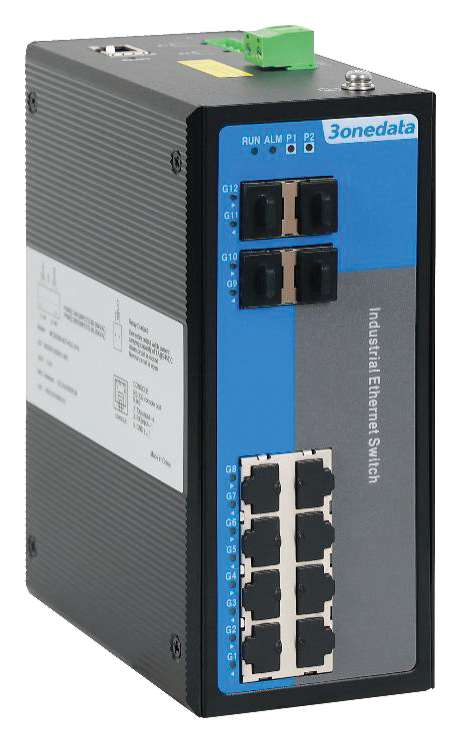
| Interface | Gigabit copper port: 10/100/1000Base-T(X) self-adaption or forced mode, RJ45, Automatic Flow Control, Full/Half Duplex Mode self-adaption, MDI/MDI-X Autotuning Gigabit SFP slot: 100/1000 Base-X SFP slot, auto-negotiation or forced mode Console port: CLI command line management port (RS-232), RJ45 Relay: Support 1 relay alarm output, adopt 2-pin 7.62mm pitch terminal blocks, the current carrying capacity is 1A@30VDC or 2A@250VAC |
| LED Indicator | Power indicator, running indicator, alarm indicator, interface indicator |
| Switch Property | Transmission mode: store and forward MAC Table address: 16K Packet buffer size: 12Mbit Backplane bandwidth: 128Gbps Switch delay: <10μs |
| Power Supply | DC products: Power supply range: 12/24/48VDC (12~58VDC), dual power supply redundancy Connection mode: 5-pin 5.08mm pitch terminal blocks Connection protection: support anti-reverse connection AC products: Power supply range: 110VDC (85~300VDC) or 220VAC (90~264VAC), dual power supply Connection mode: 5-pin 5.08mm pitch terminal blocks Connection protection: support non-polarity |
| Power Consumption | MES6300-8GT4GS-2LV: No-load at normal temperature 25℃: 6.36W@48VDC Full-load at normal temperature 25℃: 11.57W@48VDC No-load at high temperature 75℃: 8.18W@48VDC Full-load at high temperature 75℃: 13.60W@48VDC MES6300-8GT4GS-2HV: No-load at normal temperature 25℃: 5.10W@220VAC Full-load at normal temperature 25℃: 10.81W@220VAC No-load at high temperature 75℃: 6.82W@220VAC Full-load at high temperature 75℃: 12.24W@220VAC MES6300-8GT8GS-2LV: No-load at normal temperature 25℃: 8.64W@48VDC Full-load at normal temperature 25℃: 16.80W@48VDC No-load at high temperature 75℃: 9.62W@48VDC Full-load at high temperature 75℃: 18.24W@48VDC MES6300-8GT8GS-2HV: No-load at normal temperature 25℃: 6.88W@220VAC Full-load at normal temperature 25℃: 15.75W@220VAC No-load at high temperature 75℃: 8.34W@220VAC Full-load at high temperature 75℃: 16.74W@220VAC |
| Working Environment | Operating temperature: -40~75℃ Storage temperature: -40~85℃ Relative humidity: 5%~95% (no condensation) |
| Mechanical Structure | Housing: IP40 protection, metal Installation: DIN-Rail or wall mounting Dimension (W x H x D): 70mm×160mm×130mm Weight: MES6300-8GT4GS-2LV: 0.980kg MES6300-8GT4GS-2HV: 1.115kg MES6300-8GT8GS-2LV: 0.989kg MES6300-8GT8GS-2HV: 1.120kg |
| Industrial Standard | IEC 61000-4-2 (ESD, electronic static discharge), Level 4 Air discharge: ± 15kV Contact discharge: ±8kV IEC 61000-4-3 (RS, radiated susceptibility), Level 3 10V/m (80MHz~2GHz) IEC 61000-4-4 (EFT, electrical fast transient pulses), Level 4 Power supply: ±4kV Copper port: ±2kV IEC 61000-4-5 (Surge), Level 4 Power supply: differential mode±2kV, common mode±4kV Copper port: differential mode±2kV, common mode±4kV IEC 61000-4-6 (CS,conducted susceptibility), Level 3 10V rms (150kHz~80MHz) Shock: IEC 60068-2-27 Free fall: IEC 60068-2-31/32 Vibration: IEC 60068-2-6 |
| Authentication | CE, FCC Part 15B Class A, RoHS, IEC 61850-3, IEEE 1613 |
| Warranty | 5 years |