
 Date:2026-07-06
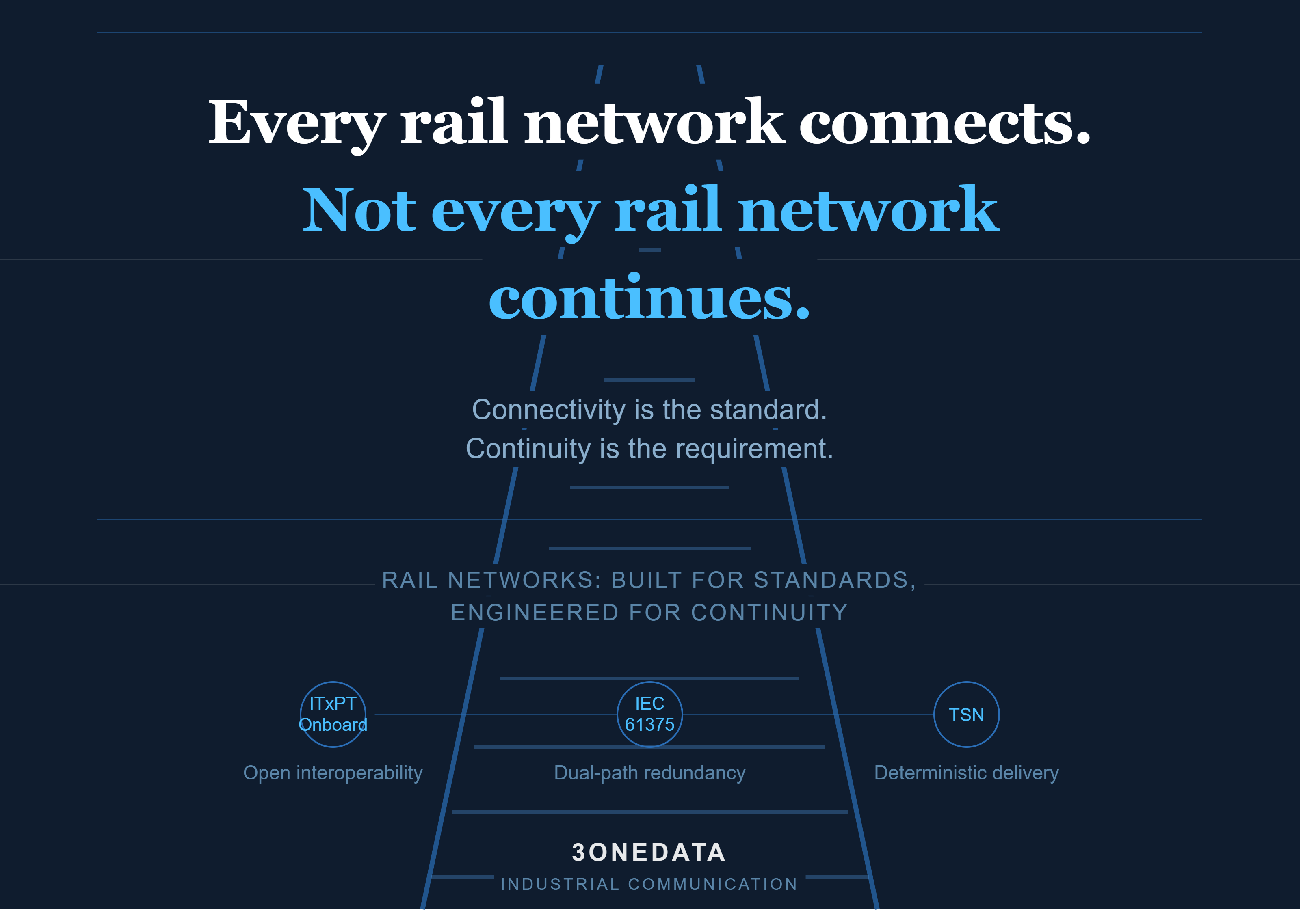
Modern rail communication networks have never been more capable — or more complex. Train control, passenger information, onboard video and real-time diagnostics are converging onto shared digital infrastructure at pace, and the international standards that govern them — ITxPT for public transport interoperability, IEC 61375 for train control networks, TSN for deterministic data delivery — have established a common technical foundation for the industry.
Standards matter. They reduce integration risk, enable multi-vendor interoperability, and establish a shared baseline that operators, integrators and suppliers can all commit to. For a rail operator deploying across multiple vehicle types, depots and control systems, compliance with ITxPT is not a bureaucratic checkbox — it is the practical prerequisite for a network that actually works as a system.
But European rail operators are also confronting a harder question, one that incidents on the continent have brought into sharper relief in recent years: a network built to standard is not automatically a network that keeps running when something inside it fails. Connectivity is the ability to link systems together. Continuity is the ability to keep the right systems communicating even when a link, a component or a network path goes down.
Both matter. And in an era when rail networks carry safety-critical control traffic alongside passenger data on the same infrastructure, the gap between them is where operational risk lives.
Where Continuity Breaks Down
The challenge is structural. As more functions converge onto a single network, a failure anywhere in that network has the potential to affect everything that runs on it. Three pain points come up consistently across rail deployments worldwide.
Multi-vendor onboard networks fragment easily. Public transport fleets routinely mix vehicle types and hardware from different suppliers. Without a common, open architecture — one that conforms to ITxPT standards and uses industrial-grade switching equipment as its backbone — vehicle-to-ground and vehicle-to-depot communication paths end up as a patchwork of proprietary links. When one breaks, there is often no automatic fallback.
Single communication paths create single points of failure. In operations that rely on flexible train coupling and recoupling — multiple units joining or splitting dynamically without fixed formation rules —a Train Control and Monitoring System (TCMS) network built on a single backbone is one link failure away from isolating a critical subsystem. When a new unit couples in, the network needs to discover it automatically and update its topology without human intervention. When a path fails, control needs to reroute itself in milliseconds, not minutes.
Best-effort networking cannot prioritize what matters most. A converged network carrying control commands, video feeds and telemetry data will, under load, treat all traffic as roughly equal unless it is explicitly told not to. In a safety-critical environment, a control signal waiting behind a video stream is not acceptable operating condition. Without deterministic scheduling, "connected" does not mean "on time."
The 3onedata Approach: Redundancy as Architecture, Not Add-On
3onedata's rail communication solutions address each of these failure modes at the architecture level — not as features added to standard equipment, but as properties designed into the network from the outset.
For public transport operators, the ITxPT-compliant onboard communication network solution uses industrial-grade switches to build a vehicle backbone that connects rolling stock, ground systems and dispatch platforms through an open, standardized architecture. The result is a network where vehicle type and supplier do not determine whether the communication path holds — and where integration across a mixed fleet does not create proprietary dependencies that become failure points.
For rail operators running dynamic train formations, the IEC 61375-based TCMS network solution is built specifically for the way trains actually operate. Its core design principle is dual backbone networks with dual-homed terminal connections: no single network path failure can isolate a subsystem from the rest of the train. Device discovery and topology updates happen automatically as trains couple or split — the network reconfigures itself, without waiting for an operator to intervene. The solution also reserves bandwidth and edge-computing interfaces for future onboard intelligence, enabling the architecture to scale without requiring a redesign.
Across both environments, 3onedata's self-developed TSN (Time-Sensitive Networking) switches and platforms provide the deterministic layer that brings continuity to converged traffic. Control signals, video and telemetry share the same physical network — but TSN scheduling ensures that critical commands are never queued behind non-critical data. Time synchronization operates at nanosecond precision; control response at millisecond speed. The network does not just carry everything. It guarantees that the most important traffic arrives first.
These architectures have been validated across some of the most demanding rail environments operating today.
In China, 3onedata's communication solutions are deployed on the 600 km/h high-speed maglev project, the CR400/CR450 "Fuxing" standard EMU programs — including the Fuxing smart train configuration — and major high-speed lines including Beijing-Xiongan, Beijing-Zhangjiakou and the Qinghai-Tibet Railway. Urban rail deployments include Shenzhen Metro Line 13 and the Chengdu Metro smart passenger service platform.
Internationally, the same solutions are running on three landmark cross-border corridors: the China-Laos Railway, the Jakarta-Bandung High-Speed Railway and the Hungary-Serbia Railway. In Europe, 3onedata's onboard and trackside communication networks are already in service on the Padua tram system in Italy and the Warsaw Metro in Poland.
Across all of these projects, the operating requirement is consistent: communication networks supporting train operation cannot have a single point of failure, and they cannot treat all traffic as equal. Redundancy and determinism are not advanced options — they are baseline requirements for networks that carry safety-critical functions.
Continuity Is a Design Decision
Rail assets stay in service for decades. The standards that govern them — and the threats they face — do not stand still for that long. A network architecture built only for today's connectivity requirements, without headroom for redundancy, deterministic scheduling and future system growth, will require increasingly costly intervention to keep pace.
The operators best positioned for the next generation of rail operation will not simply be those who met the interoperability standard. They will be those who treated continuity — not just connectivity — as the design requirement from the first day of the project.
That is the principle behind every communication network 3onedata has built for rail.
About 3onedata
As a leading brand in industrial connectivity with abundant key technologies, has pioneeringly introduced the concept of HaaS (Hardware as a Service),boasts comprehensive R&D capabilities for a full range of software and hardware products in the industrial automation field, including industrial Ethernet switches,networking, wireless, and automation control systems.Solutions are widely applied in industrial automation and intelligent manufacturing, with numerous cases.Overall ranked the No.1 in Industrial Communication field with over 70 million pieces of products running worldwide.
Website: www.3onedata.com
LinkedIn: 3onedata
Business Contact: Mr. Colin Cong, E-mail: ims@3onedata.com